Biofilter Network, Wetlands
and Solar Stations
Low-cost ecological infrastructure for water restoration in San Gregorio Atlapulco. Combining physical, chemical and biological processes with local mineral materials, solar energy and community participation.
From filter to ecosystem
The Biofilter and Artificial Wetland Network of San Gregorio is a low-cost ecological infrastructure proposal to improve water quality in the agricultural systems and canals of Xochimilco, combining physical, chemical and biological processes.
The project originated in the Humedal San Gregorio 1, where biofilters were designed for ditches with modules built with wood and galvanized mesh, using mineral materials and adsorbents such as tezontle, tepojal and activated carbon.
The key question:
Not "how do we filter water?" but "how do we design the conditions for water to sustain life again?"
Objectives
Design, implement and document a Community Network of Biofilters and Artificial Wetlands using locally available mineral materials, low-cost technologies, solar energy and natural filtration, adsorption and biodegradation processes.
Hydraulic
Reduce suspended solids load and other contaminants through prefiltration systems and granular media.
Physicochemical
Use materials with different properties of filtration, adsorption, ionic exchange, particle retention and biofilm support.
Biological
Create conditions for the development of microorganisms, plants and aquatic communities.
Energy
Integrate pumping stations powered by solar energy.
Agricultural
Improve water conditions for chinampera production systems.
Ecological
Contribute to habitat recovery for native aquatic species.
Educational
Create a model that any community can study, adapt and reproduce.
Current Network
Biofilters currently installed in Xochimilco, plus a pilot project using hair booms.
San Gregorio Atlapulco
~202 m
Network of ditches with multiple biofiltration points. Main section of 139 m with several modules distributed across the system.
19.2575, -99.0918
Cuemanco
105 m
Linear biofilter installed in the chinampera zone of Cuemanco.
19.2700, -99.1000
Laguna del Toro
80 m
Biofilter at Laguna del Toro, lacustrine zone of Xochimilco.
19.2800, -99.0800
Pilot Project: Hair Booms
Experimental project using hair booms to test their effectiveness in water decontamination. An innovative approach to explore natural absorbent materials for canal water treatment.
How a trench biofilter works
A trench biofilter is essentially a subsurface flow artificial wetland. Imagine a ditch excavated in the soil, filled with gravel of different sizes and planted with the species we just saw. Wastewater enters at one end, flows slowly through the gravel and roots, and exits clean at the other end.
The water is never exposed to air; it always circulates below the surface. This has several advantages: it prevents bad odors, stops mosquito proliferation and, above all, protects the system from low temperatures, keeping root and microorganism activity even in winter.
Cleaning is not done by plants alone. A film of bacteria forms on the gravel that decomposes organic matter and transforms ammonia nitrogen into less polluting forms. Plant roots, like tule or carrizo, pump oxygen into this environment, helping those bacteria work better.
The combination of plants and microorganisms is what makes these systems so effective, achieving organic matter removal (BOD and COD) above 90% and nearly eliminating fecal coliforms.
>90%
BOD and COD removal
~100%
Fecal coliform elimination
Subsuperficial
Water flow
Subsurface flow
Water never exposed to air
Bacterial biofilm
Decomposes organic matter
Year-round active
Roots + microbes in winter
How a Wetland Really Cleans Water
The wetland is not just a "green pond". It is a reactive system where physics, chemistry and biology converge to remove contaminants through sedimentation, adsorption, ionic exchange, phytoremediation and microbial transformation.
Much of the initial cleaning occurs without direct plant intervention, through physicochemical processes acting on dissolved and suspended contaminants.
Sedimentation and Filtration
The wetland design slows water flow. This low velocity allows suspended solid particles to settle by gravity. Additionally, the dense root network and substrate itself act as a physical filter trapping these particles.
Adsorption and Ionic Exchange
This is one of the most important processes for retaining heavy metals and nutrients. The wetland substrate (gravel, sand, clay) and accumulated organic matter have electrically charged surfaces. Dissolved metal ions such as cadmium (Cd²⁺), lead (Pb²⁺) or copper (Cu²⁺) are electrostatically attracted and adhere to these surfaces. This process is known as adsorption.
Ionic Exchange with Zeolites
A particularly efficient case is ionic exchange. Materials such as zeolites (sometimes added to the substrate) have a porous structure with high cation exchange capacity. Contaminating metal ions are captured by the zeolite, which releases non-toxic ions such as sodium (Na⁺) or calcium (Ca²⁺) in exchange. Retention capacity by ionic exchange is strongly influenced by pH; generally, a higher pH (less acidic) favors metal precipitation and adsorption, while a low pH tends to keep them dissolved and mobile.
Precipitation and Coprecipitation
Contaminants can also be removed from water by forming insoluble solid compounds. For example, phosphorus, a key nutrient causing eutrophication, can precipitate by reacting with calcium, iron or aluminum ions present in the water or substrate, forming compounds that deposit at the bottom. Coprecipitation is a similar process where a contaminant ion incorporates into the crystalline structure of another mineral that is precipitating, thus becoming immobilized in the sediment.
💧 The Synergy in Action: The Wetland as a Whole
The artificial wetland functions as an integrated whole. Plants transport oxygen through their tissue (aerenchyma) to the roots, releasing it into the rhizosphere. This creates aerobic microzones that allow nitrifying bacteria activity. At the same time, oxygen-free (anoxic) zones in the substrate are the perfect habitat for denitrifying bacteria.
Contaminants are retained by the substrate (adsorption, precipitation), absorbed by plant roots (rhizofiltration, phytoextraction) and transformed by microorganisms (nitrification, denitrification). This combination of physical, chemical and biological pathways is what makes artificial wetlands such effective and sustainable treatment systems.
Substrate
Adsorption · Precipitation
Plants
Rhizofiltration · Phytoextraction
Microbes
Nitrification · Denitrification
System Architecture
The network is organized as a succession of modules. Not all systems need all layers — selection depends on water quality, flow and treatment goals.
Water treatment flow
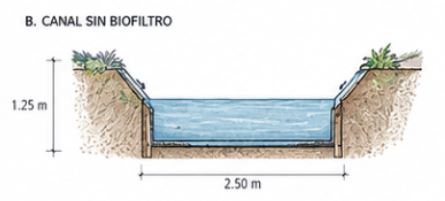
B. Canal without biofilter
Base cross-section of the canal before installation.
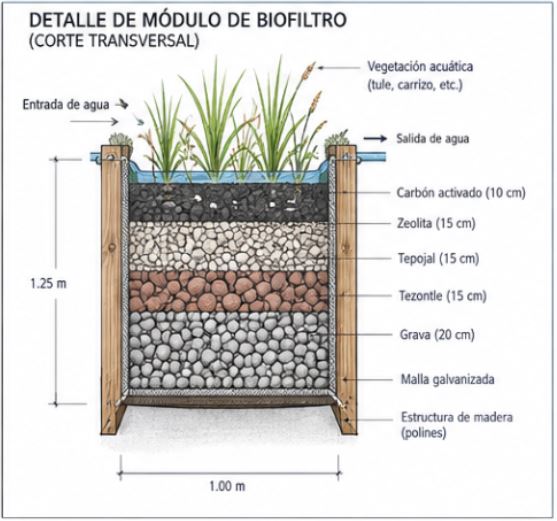
Module cross-section
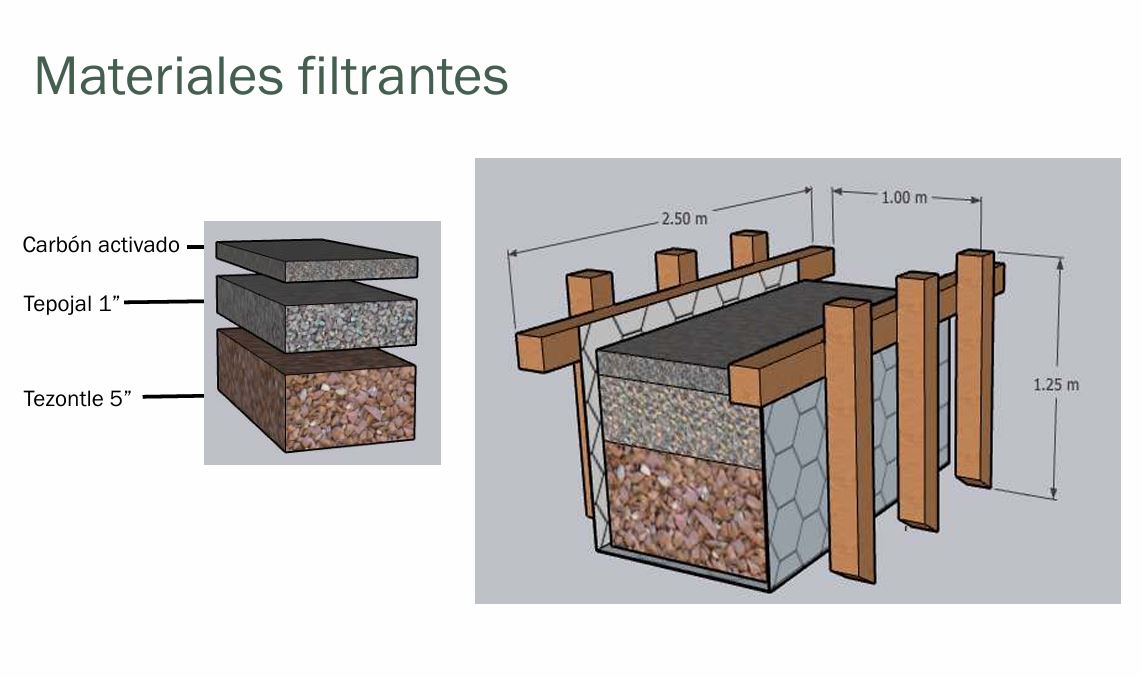
Structure with posts, galvanized mesh and filter layers.
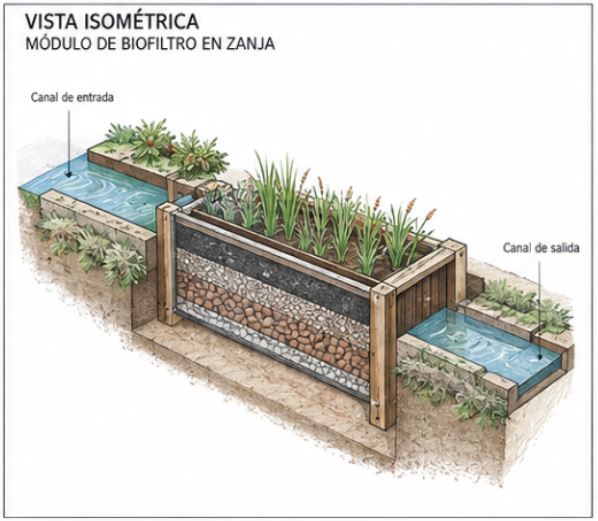
Isometric view
Biofilter module in trench with water inlet and outlet.
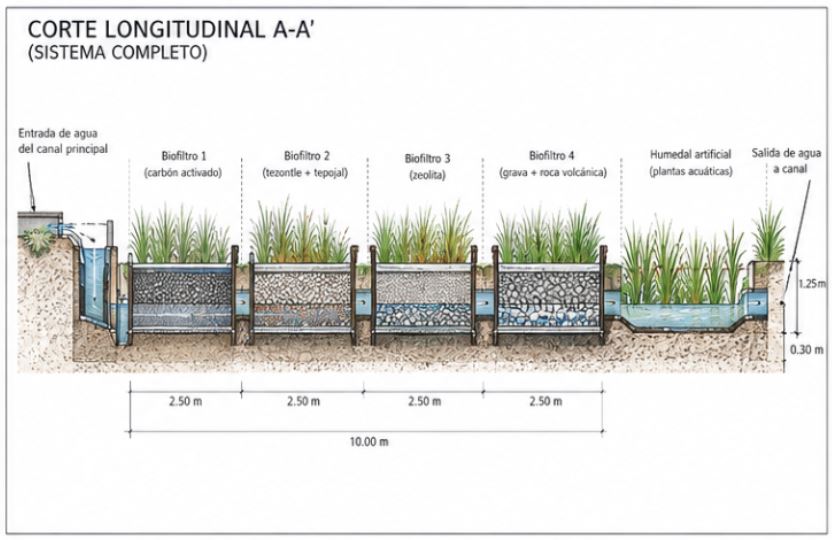
Longitudinal section A-A'
Complete system: inlet, 4 biofilters, wetland and outlet (10 m).
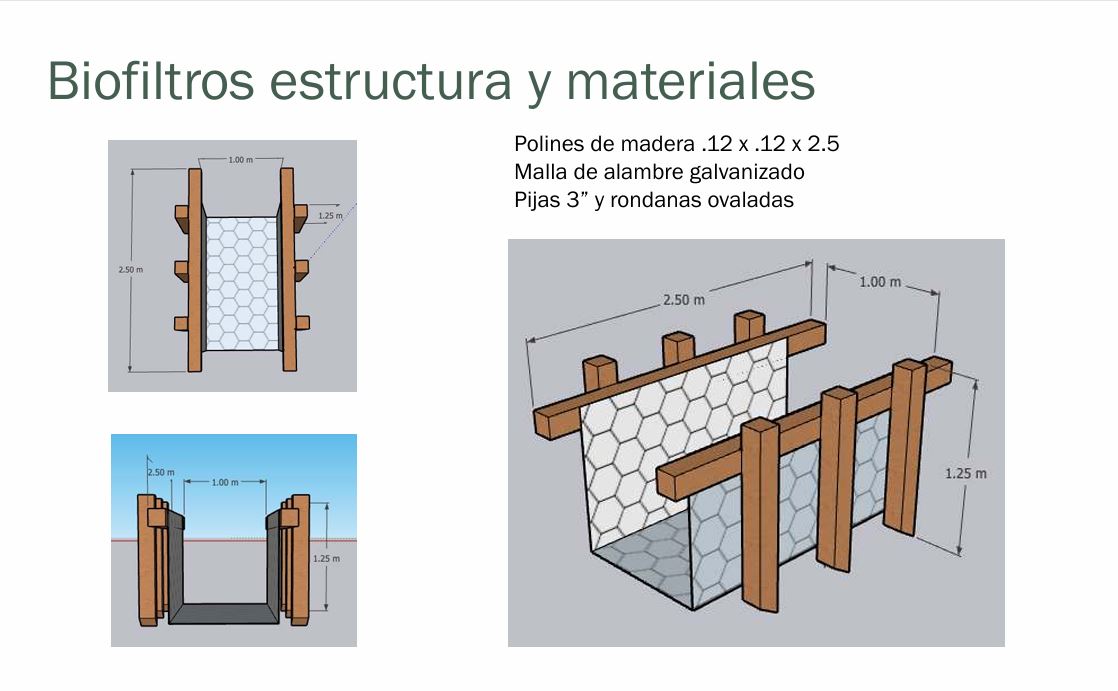
Structure and materials
Wooden posts .12×.12×2.5, galvanized wire mesh, 3" screws and oval washers.
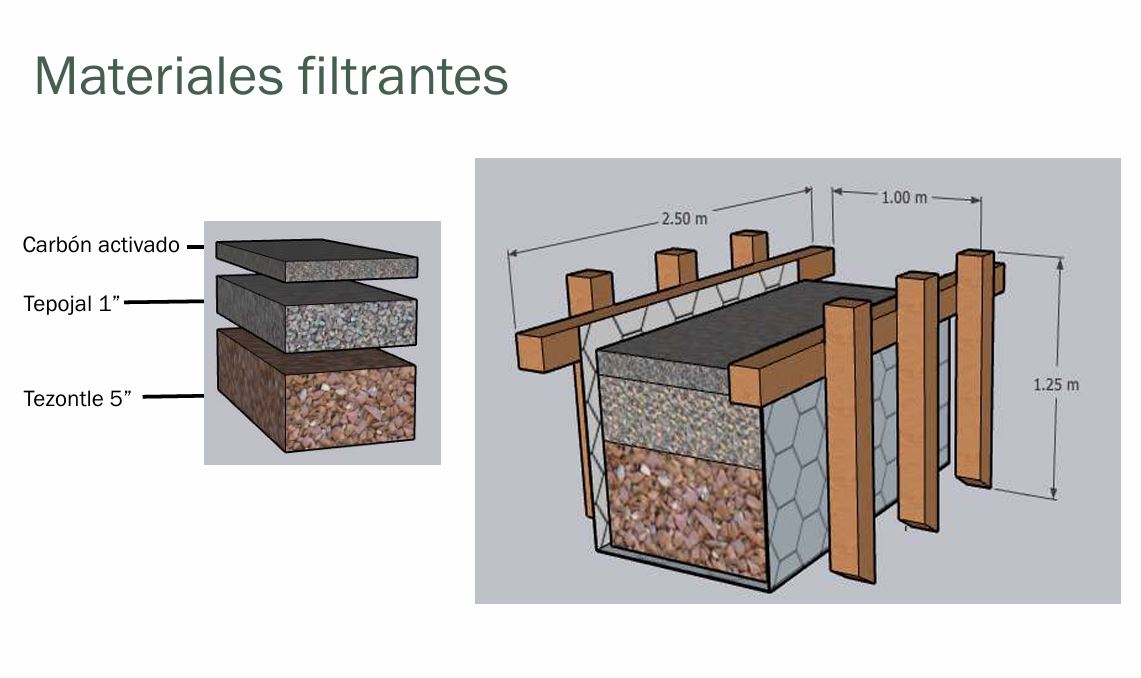
Filter materials
Activated carbon, tepojal 1" and tezontle 5" layers in the module.
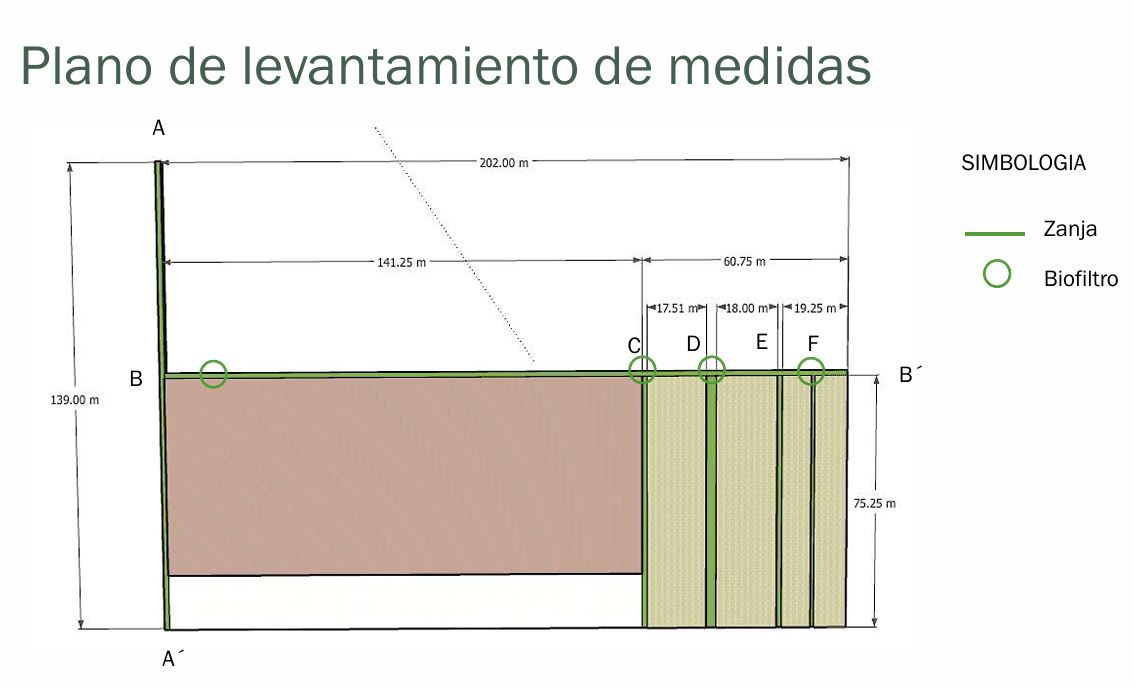
Measurement survey plan
Total length: 202 m. Main section: 139 m. Ditches A-A', B-B', C, D, E and F.
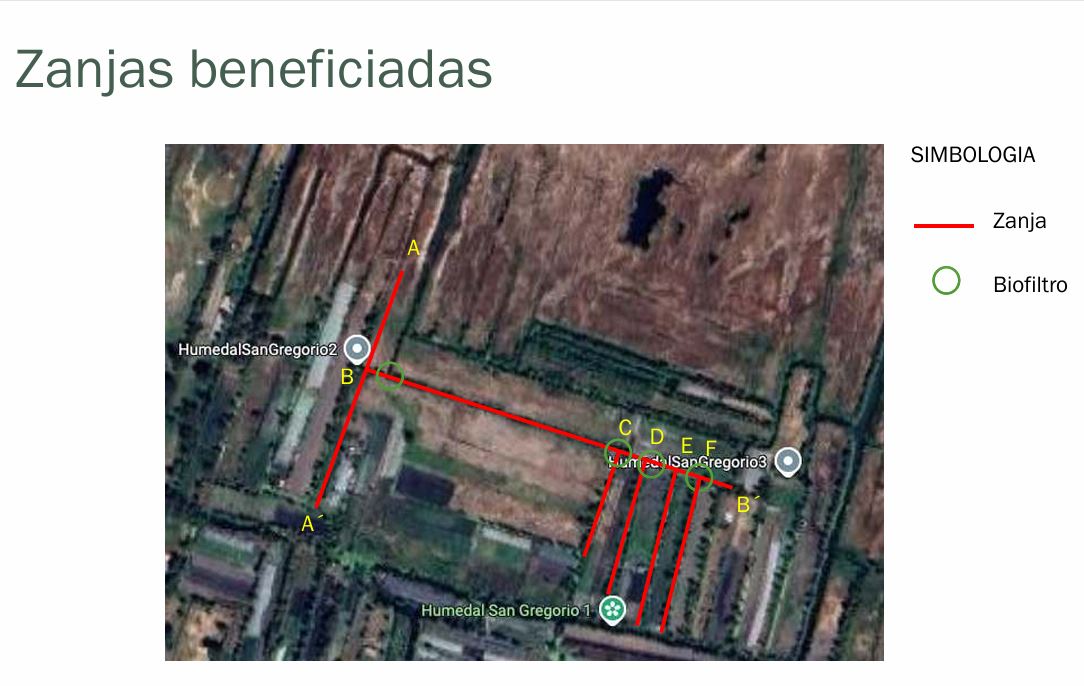
Benefited ditches
Map of the biofilter network in San Gregorio: ditches A-A', B-B', C, D, E and F with biofiltration points.
Filter Media Catalog
12 technical sheets of filter materials. We distinguish between physical filtration, adsorption, ionic exchange, biological support and demonstrated removal.
Filtering Vegetation
Six aquatic plant species with documented phytoremediation capacity for heavy metals, nutrients and bacteria in constructed wetlands.
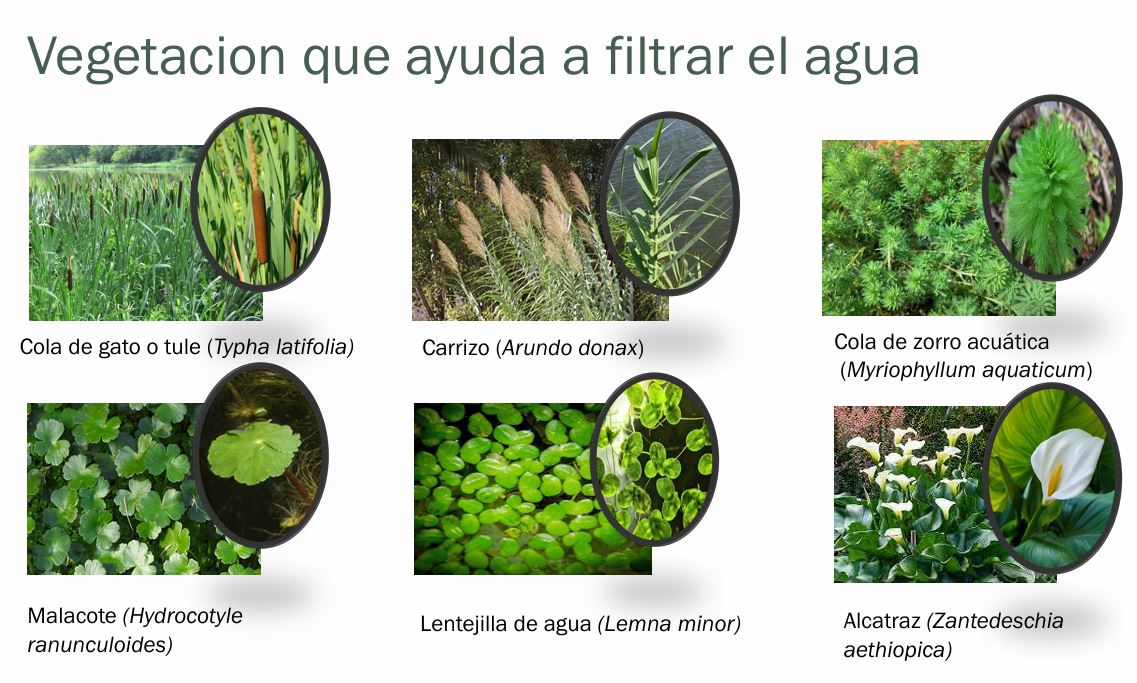
Cola de gato o tule
Typha latifolia
Habitat
Wetlands, lake and river banks
How it cleans water
One of the most used plants in phytoremediation because its roots actively absorb heavy metal ions like cadmium, arsenic, lead and zinc. It releases oxygen through its roots, immobilizing metals in the substrate. It activates antioxidant enzymes in its leaves to tolerate and accumulate contaminants without dying.
Documented efficiency
Removals above 90% of ammonium and phosphates in wastewater. For iron, lead, copper and zinc, proven phytoremediation potential.
Placement in wetland
Tall species (2-3 m) at the wetland inlet, as a physical barrier and sediment trap.
Carrizo
Arundo donax
Habitat
Moist soils, riverbanks, disturbed areas
How it cleans water
Fast-growing, large plant that accumulates heavy metals in its tissues. Absorbs lead, cadmium and arsenic. For arsenic it can transform and release it as gas (phytovolatilization). Notable efficiency, with 94% to 98% metal removal in industrial waters.
Documented efficiency
94%-98% metal removal in industrial waters. Bioaccumulation factor >1 for lead.
Placement in wetland
Large species (4-6 m) in the subsurface flow zone. Ideal for removing large volumes of contaminants.
Malacote
Hydrocotyle ranunculoides
Habitat
Freshwater environments, pond and stream edges
How it cleans water
Creeping plant with high absorption capacity for copper, manganese and aluminum. These metal ions accumulate mainly in its roots and leaves. So effective that copper removals of 98.9%, manganese 73% and aluminum 59.4% have been documented.
Documented efficiency
Copper 98.97%, manganese 73.01%, aluminum 59.40%. Phytoremediation capacity for mercury.
Placement in wetland
Creeping species forming dense surface cover. Surface flow zone or edges.
Lentejilla de agua
Lemna minor
Habitat
Still waters, ponds, eutrophic lakes
How it cleans water
Pure ionic exchange mechanism. The plant acts as a chemical magnet: heavy metal ions like lead, cadmium, nickel or zinc are exchanged for benign ions already in its biomass, like potassium or calcium. Adsorption occurs in the cell wall and is very efficient for polishing water.
Documented efficiency
Zinc 78.69% in 7 days. Nickel removal at low concentrations. Copper phytoremediation in mining waters.
Placement in wetland
Floating species on polishing ponds or final wetland zone.
Cola de zorro acuática
Myriophyllum aquaticum
Habitat
Freshwaters, slow streams, ponds
How it cleans water
Cadmium hyperaccumulator. Its ionic action is dual: part of the metal enters by passive diffusion with transpired water (apoplastic pathway), and another part is actively absorbed via an energy-consuming process (cellular pathway). This combination makes it extremely efficient.
Documented efficiency
Chromium 99.6% in 80 hours. Copper 95.2%, lead 94.28%, mercury 99.19%, zinc 91.91%. >90% for coliforms, phosphate, iron and zinc.
Placement in wetland
Submerged-emergent species in the horizontal flow zone. Maximizes surface area for ionic absorption.
Alcatraz
Zantedeschia aethiopica
Habitat
Wetlands, swamps, watercourse edges
How it cleans water
Accumulates metals like lead, copper and chromium in roots, stems, leaves and flowers. The process follows pseudo-second-order kinetics, meaning metal ion adsorption is fast and pH-dependent. Also very effective at reducing fecal bacteria load.
Documented efficiency
Total coliforms 92.12%. Total removal 37% in biodigester pool wastewater.
Placement in wetland
Ornamental species of medium height (0.8-1.2 m) at wetland edge zones.
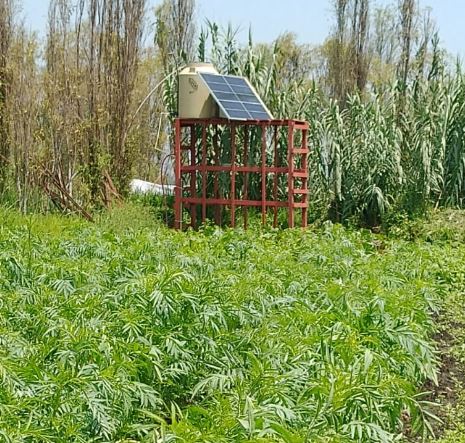
Solar Filtration Station
A solar-powered station installed directly in the field that filters, oxygenates and irrigates — all without conventional electricity.
1,800 L
every 4 hours of filtration
Oxygenation
of the canal system
Irrigation
solar irrigation station
Research Program
Each biofilter has a data sheet. We compare combinations of materials to discover what works best under the real conditions of Xochimilco.
Experimental filter media matrix
| System | Grava | Tezontle | Tepojal | Zeolita | Carbon |
|---|---|---|---|---|---|
| A | ✓ | ✓ | ✓ | — | — |
| B | ✓ | ✓ | ✓ | ✓ | — |
| C | ✓ | ✓ | — | ✓ | ✓ |
| D | ✓ | — | ✓ | ✓ | ✓ |
Parameters we measure
We transform simple mineral materials, solar energy and natural processes into accessible ecological infrastructure.
To recover water, agriculture and biodiversity.
Construction Manual
Step-by-step guide for building a biofilter module with locally available materials.
Join the Network
Four ways to support the restoration of water in Xochimilco.
Citizen Donation
Support the construction and maintenance of biofilters in Xochimilco.
Corporate Help
Companies can contribute with materials, funding or volunteer teams.
I am a chinampero
My water is contaminated. I want to apply for a biofilter on my chinampa.
Donate a biofilter
I would like to donate a biofilter to a chinampero.